The right care preserves both appearance and function
The basic rule: vacuum regularly, deal with spills as soon as possible, and always use a cleaning method suitable for the specific Melkea product.
How often a floor needs cleaning depends mainly on use, foot traffic and environment. Entrances, corridors and other high-traffic areas normally need more attention than low-traffic areas.
High traffic
Entrances, receptions and corridors may need vacuuming daily or more often.
Normal traffic
Offices, meeting rooms and similar spaces are cleaned regularly as needed.
Low traffic
Clean as needed, but check the surface regularly.
01
Prevent dirt
Much of the dirt on a floor is brought in via shoes and entrances. A good entrance zone with a scraper mat reduces the amount of dirt carried onto the textile floor. Keep entrance zones clean and adapt cleaning effort to traffic and weather.
02
Regular vacuuming
Vacuuming is the foundation of ongoing maintenance. Dust and grit left in place work down into the textile and contribute to wear. Use a vacuum cleaner suitable for textile floors and work methodically across the surface.
03
Spills and stains
Deal with spills as soon as possible. Blot up the liquid with a clean, absorbent cloth, working from the outer edge of the stain towards the centre. Blot rather than rub, use as little liquid as possible, and let the surface dry before it is used again.
04
Dried-in stains
Carefully loosen the material sitting on top of the surface, vacuum the area, and treat any remaining stain according to the care instructions for the specific Melkea product.
05
Cleaning agents
Use products intended for textile floors and suitable for the collection in question. Always test on a small, inconspicuous area first, follow the manufacturer's dosage, and avoid agents that leave a sticky or greasy residue.
06
Dry cleaning
Several Melkea collections specify dry cleaning / dry shampoo as the recommended method – a low-moisture method where the cleaning material and dirt are subsequently removed from the textile.
07
Deeper cleaning
When vacuuming and spot treatment are not enough, more thorough cleaning may be needed. The method depends on the product's construction, backing and the manufacturer's recommendations.
08
Replace a single tile
A damaged or heavily soiled tile can, in many installations, be replaced individually. It is therefore worth keeping a few spare tiles after installation – store them dry and flat.
Quick guide
Dust / everyday dirt
Vacuum regularly, adjusting the frequency to traffic.
Fresh spills
Blot up quickly with a clean cloth, working from the edge towards the centre.
Dried-in stains
Loosen carefully, vacuum, and follow the product's care advice.
More thorough cleaning
Follow the recommended method for the specific collection.
Damaged tile
Replace the individual tile if the installation allows it.
Note: the product-specific care recommendation always takes precedence over this general guide. Always check the current product information before choosing a cleaning method or cleaning agent.
02 — Product data
Which Melkea should you choose?
All collections are supplied in 50 × 50 cm tiles. Below you'll find material, construction, wear class and stated maintenance method.
Office
Offices and demanding commercial environments.
Fibre
100% Solution Dyed Nylon (PA)
Construction
Loop pile
Thickness
5.5 mm
Wear class
33 – commercial use
Maintenance method
Dry cleaning / dry shampoo
Format
50 × 50 cm
Stone & Story
Projects that combine design, material feel and a high wear class.
Fibre
100% Nylon PA6
Construction
Loop pile (scroll loop)
Thickness
5.8 mm
Wear class
33 – commercial/public use
Maintenance method
Dry cleaning / dry shampoo
Format
50 × 50 cm
Harmony
The home when softness and a cosy feel are the priority.
Fibre
100% Polyester (PES)
Construction
Cut pile
Thickness
13 mm
Wear class
23 – heavy domestic use
Maintenance method
Dry cleaning / dry shampoo
Format
50 × 50 cm
Home Of Quality
Everyday use in the home.
Fibre
100% Polypropylene (PP)
Construction
Loop pile
Thickness
4.7 mm
Wear class
22 – general domestic use
Maintenance method
Dry cleaning / dry shampoo
Format
50 × 50 cm
03 — Installation guide
Laying textile tiles – step by step
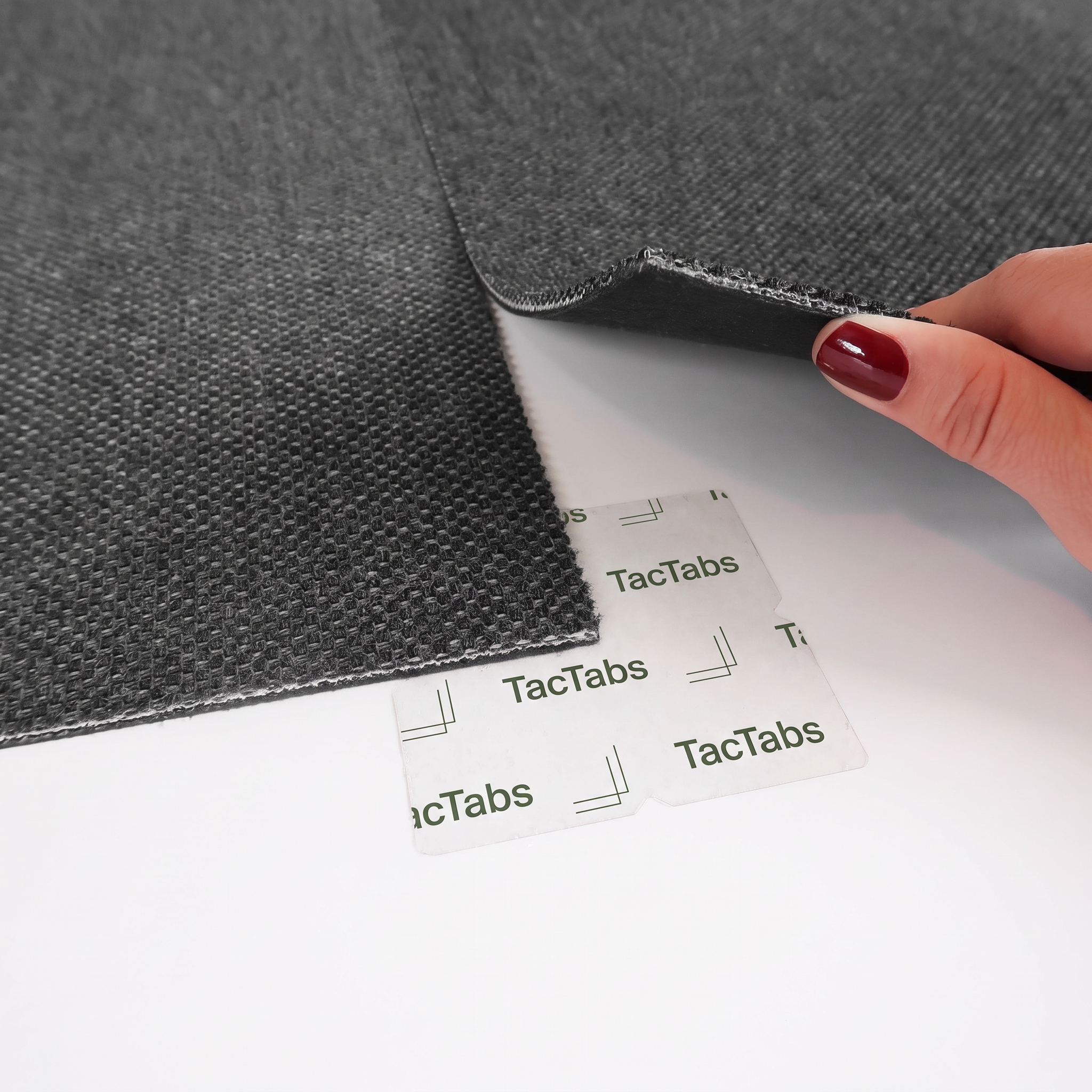
Laying textile tiles is simple and requires no permanent gluing. With adhesive tabs holding the joints together, you get a durable, professional result – and the option of replacing individual tiles when needed.
Benefits
—Minimal waste during installation
—No permanent gluing required
—Full or partial coverage installation
—Easy to replace individual tiles
01
Preparation
Make sure the subfloor is dry, clean, level and free from adhesive residue and grease.
02
Find the starting point
Draw two perpendicular chalk lines across the full length and width of the room. Always start in the centre of the room – not along a wall – to minimise waste and get even edges against all walls.
03
Choose an installation method
An arrow on the back of each tile shows the pile direction. Choose a pattern based on the look you want – monolithic, quarter-turn, brick, ashlar or random.
04
Cut the tiles
The outermost tiles usually need to be cut with a carpet knife or snap-off blade. Always cut from the back and place the untouched side against the neighbouring tile. Offcuts can be reused within the same room.
Laying patterns
An arrow on the back of each tile shows the pile direction. Choose your method according to the pattern you want.
Monolithic
All arrows point the same way, giving a uniform floor.
Quarter-turn
The arrow is rotated 90° alternately, creating a checkerboard pattern.
Brick
Arrows in the same direction, each tile offset by half a row horizontally.
Ashlar
Arrows in the same direction, each tile offset by half a row vertically.
Random
Tiles are placed with no repeating pattern – also produces less waste.
Start in the centre of the room using the chalk lines.Fit and trim the tiles against the wall.
04 — FAQ
MEL – your guide to textile tiles
MEL helps you understand textile tiles – from materials and care to acoustics, installation and which Melkea collection suits you best.
About textile flooring
What is a textile tile?+
A textile tile is a modular textile floor made up of individual tiles, typically 50 × 50 cm. Individual tiles can be lifted and replaced as needed, making the solution flexible both during installation and over time.
Why choose textile tiles?+
Textile floors can contribute to a more pleasant acoustic environment, give a softer underfoot feel, and open up great possibilities with colour, texture and laying patterns. The modularity means a damaged tile can often be replaced individually. It's worth keeping a few extra tiles from the installation.
Do textile tiles improve the acoustic environment?+
Yes, through both sound absorption and impact sound reduction. The effect depends on the product's construction, the subfloor and the room's design. For Stone & Story, ΔLw of 23 dB (EN ISO 10140) and αw of 0.16 (H) according to EN ISO 354 are specified.
Allergies, cleaning & maintenance
Are textile tiles good for allergy sufferers?+
The fibres can trap dust, pollen and other particles rather than letting everything lie loose on the floor surface – which is why regular, effective vacuuming is important. It's not possible to say generally that textile tiles are allergy-friendly; instead, consider the whole indoor environment: cleaning, ventilation, moisture and other materials.
How often should I vacuum?+
It depends on how much the floor is used. At least once a week is a reasonable starting point for normal use. Entrances, hallways and corridors may need it more often. Vacuum slowly and thoroughly so the vacuum cleaner has time to pick up the dirt.
What do I do if I spill something?+
Deal with the spill as quickly as possible. Blot up the liquid with paper towel or a clean cloth, blotting rather than rubbing. If a cleaning agent is needed, test it first on a small, inconspicuous area and use one suitable for the product.
Can I use ordinary cleaning products?+
Be careful. Different fibres and backings can react differently. Avoid all-purpose cleaners on all products, follow the product's care instructions, and avoid strong or bleaching agents unless explicitly approved.
How often does the whole floor need cleaning?+
There's no universal interval – a bedroom and an entrance hall experience completely different levels of wear. Assess the floor's actual condition and follow the product's recommended maintenance method.
Can textile tiles be wet-cleaned?+
Not all textile tiles are designed for the same cleaning method. Melkea's collections specify dry cleaning as the recommended maintenance method, so we do not generally recommend wet cleaning. For more thorough cleaning, follow the specific care instructions for the collection.
Why is it smart to keep a few spare tiles?+
Because life happens. A tile can pick up a stubborn stain, get damaged during a move, or need replacing after long use. With a few spare tiles, you can replace just the affected tile instead of the whole floor.
Classes, fire & anti-static
What do wear classes 22, 23 and 33 mean?+
The wear class describes the product's classified area of use and performance – it should not be read as a guaranteed number of years. 22 = general domestic use, 23 = heavy domestic use, 33 = commercial and public use.
What do fire classes Bfl-s1 and Cfl-s1 mean?+
The fire classification describes how the flooring product reacts in a fire according to the relevant standard. Office, Stone & Story and Harmony are rated Bfl-s1 in the product specifications. Home Of Quality is rated Cfl-s1.
Is Melkea anti-static?+
Office is rated anti-static, with documented electrostatic values: walk-on test −0.1 kV, horizontal electrical resistance 3 × 10⁸ Ω and vertical resistance 4 × 10⁹ Ω. Stone & Story is also rated anti-static.
Installation & certifications
How is Melkea installed?+
Melkea is designed as a modular floor and can be loose-laid on a suitable subfloor. The subfloor should be dry, clean, level and stable, and free from grease, wax and loose particles. Depending on the subfloor and room size, additional fixing may be needed – for Office, installation with Melkea TacTabs is specified. Always follow the current installation instructions.
What do the certifications and tests mean?+
Standards and tests describe properties such as fire performance, wear, dimensional stability, colour fastness, wear class, acoustics, electrostatic properties and emissions. For Office, Eurofins Indoor Air Comfort Gold, TÜV ProfiCert Product Interior, GUT Emission Control, A+ Emissions dans l'air and CE/EN 14041 are specified. For Stone & Story, Eurofins Indoor Air Comfort Gold is specified.
Next step
Have more questions?
Whether you're planning a home, office, hotel, shop or a larger project, there's a Melkea collection worth a closer look.